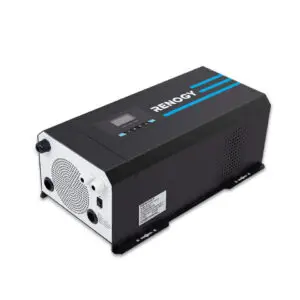
Here is three strong brands: Victron, Renogy and CTEK.
Here are some reasons you’re going to want to highlight — with a forward-thinking tone:
Proper charge algorithm = longer battery life
Cheap chargers often just dump current and hope for the best. A good charger uses multi-stage charging (bulk → absorption → float → maintenance) and adapts to battery status. That reduces stress, sulphation (in lead-acid), internal damage (in LiFePO₄) and increases cycle life.
Correct voltage and current for the battery type
If you under-charge, you get poor performance; if you over-charge, you risk gassing, damage, heat. A quality charger tailors the voltage (absorption, float) and current. This is especially important if you have different battery chemistries (AGM, gel, LiFePO₄) or on-board/off-grid systems.
Temperature/usage compensation
Real world: the charger sits in hot engine compartments or cold garages (Sweden!). Good units will adjust for temperature, reduce output if overheating, protect against over-voltage or reverse polarity. Without that, you get premature battery failure or unsafe conditions.
Efficiency & monitoring
Waste heat is lost energy (and a risk). Modern chargers include smart features: Bluetooth monitoring, recovery of deeply-discharged batteries, status logging, even remote monitoring. For your audience (solar / mobile / boat / van folks) these features add real value.
Matching system scale & battery bank size
Using a tiny charger on a large battery bank means very slow charging or incomplete absorption; using a large one but wiring badly can cause cable losses, heat, and damage. A good charger gives spec-matched current (e.g., 20A, 50A) and considers system voltage drops.
Here are three brands with good examples
Example product: Victron Energy Blue Smart IP22 Charger 12 V/30 A
Input: 100-130 VAC (for the 12/30 model) when used in workshop/AC context.
Efficiency: e.g., one datasheet shows 93% for certain models
For the Blue Smart IP67: “Adaptive 5-stage charge algorithm – bulk, absorption, recondition, float, storage”. victronenergy.com
Features: Built-in Bluetooth connectivity (in many models) so you can monitor via smartphone. victronenergy.com
Example high current model: Victron Centaur 12/100 – 12 V, 100 A output, universal input 90-265 VAC
Why this matters: Victron units show strong performance: high efficiency, good algorithm, good features for monitoring. For a serious battery bank (house, marine, van) this is the kind of charger you want. Yes—they cost more, but you’re buying the long-term health of the battery.
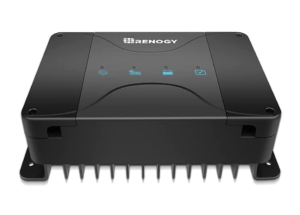
Example product: Renogy 12 V 40 A DC‑to‑DC On‑Board Battery Charger
Why this matters: Renogy offer good value for mobile/vehicle/battery bank folks. If someone is doing a van conversion, solar/battery system, this kind of charger fits very well: robust, vehicle-friendly, multiple battery chemistries. It illustrates your point of “right charger for right system”.
Example product: CTEK MXS 5.0 Battery Charger
Specification: 12 V lead-acid batteries; max charge current ~4.3 A
8-step fully automatic charging cycle
Protection rating: IP65 (splash & dust proof)
There is also the Lithium US 12V version: for LiFePO₄ (5-60Ah)
Why this matters: CTEK is more “maintenance/vehicle/consumer” oriented. Good for smaller batteries, keeping them healthy, especially if you have a vehicle or auxiliary battery. It may not cover large banks at 50A+, but still plays a critical role: making sure batteries that are dormant or under-used get proper charging rather than neglected.
Many van/boat conversions add solar panels and a service battery but forget: when the vehicle’s engine is running (or a solar battery is full) the service bank may never see a proper charging voltage. Enter 12/12 DC-to-DC chargers: They guarantee the service battery gets the correct absorption/float voltages, even when input voltage is low, or cables long.
Brand comparisons:
• Victron’s Orion-Tr Smart 12/12 series: premium, Bluetooth monitoring, isolated/non-isolated choices, very flexible.
• Renogy’s 12/12 models (20A/40A/50A): value-focused, vehicle-friendly, solid for van builds.
When you need one: Long cable run from alternator to service battery, smart-alternator vehicle that drops voltage, mismatched battery chemistries (e.g., starting battery lead-acid + aux battery LiFePO₄), multiple power sources.
When you might not need one: Simple system: one battery bank, short wiring, standard alternator, no separate service battery. In that case a standard charger or direct wiring may suffice.
Installation tip (plug your skeptical hat on):
Wire gauge matters: if you have a 20 A charger but run thin wires with 2 m of length, you’ll get voltage drop — defeats the point.
Heat & ventilation: many of these units sit under seats or in cramped van spaces — if they overheat their current output may be reduced.
Matching to battery: Make sure you configure the charger for the correct battery chemistry. If you connect a LiFePO₄ cell but leave the charger on standard AGM mode you’ll under-charge or worse.
Monitoring: Even good chargers don’t fix bad cable/wiring. Having Bluetooth/remote monitoring (as Victron offers) lets you spot voltage drop, high temps, etc rather than assume “it’s charging fine”.
A “12/12” charger (or 12 V input → 12 V output) is basically a device that takes a 12 V source (often the vehicle’s starting/alternator battery) and charges a second 12 V battery bank (service/auxiliary battery) while compensating for issues like cable losses, smart alternator voltage drop, different battery chemistries, etc.
Here are key benefits:
In many vehicles, when the alternator is smart or the wire run is long, the voltage at the service battery may drop to e.g. 12.6-13 V, which is not enough for full charge. A DC-to-DC charger boosts/regulates it to proper absorption/float voltages (e.g., ~14.2-14.6 V depending on battery type). The subreddit discussion echoes that:
“If you put a 12v to 12v DC-DC Converter Charger near the RV battery … then you can get 14v output … even if input is 9.5v” Reddit
It also allows for different chemistries: e.g., your input battery might be standard lead-acid, your service bank might be LiFePO₄, AGM, etc. A good DC-to-DC charger will allow that and handle different amp ratings.
It ensures the service battery is properly charged while driving (vehicle/van) or while you have a source battery charged by solar/alternator. Without it, your service battery may be permanently under-charged, shortening its life.
In short: If you have a dual battery system (starter + house/aux), or long cable runs, or smart alternator, then a 12/12 DC-to-DC charger becomes very relevant.
Victron’s “Orion‐Tr Smart” series supports 12V/12V (and also 12/24, etc) models. victronenergy.com+2victronenergy.com+2
Features: 3-stage charging algorithm (bulk → absorption → float) designed for dual batt systems. victronenergy.com
Built-in Bluetooth for monitoring/configuration via VictronConnect app. Amazon+1
Some models isolated (input and output grounds separate) – useful for noise, ground loops. victronenergy.com
Example spec: 12 / 12-18 A (220 W) model is one variant Amazon
Why good: High-end, very flexible. If you’re writing for serious mobile/van/boat folks: a big plus. The ability to monitor, fine tune, and handle differing chemistries is a strong selling point.
Points to mention/Skepticism:
Cost will be higher.
Installation still matters (wire gauge, proximity to batteries, ventilation).
If your system is simple (just one battery bank, short cables), the premium may not be necessary.
For example: Renogy 12V-20A DC to DC charger: Input system voltage: 12 V-12 V. System voltage 12-12. Off Grid Stores+1
Larger variant: 12V-50A (or 12V-60A) DC to DC with MPPT input, for larger battery banks. Renogy EU+1
Compatible battery types: AGM, Gel, Flooded, LiFePO₄. Renogy US+1
Efficiency: around 94% for the 20A model. ShopSolar.com
Special for mobile installs: includes wiring for alternator-detection, compact for vehicle installation. Renogy US
Why good: More value oriented than very premium brands. Great for van conversions, car-based battery banks, where you want DC-DC and are maybe on a tighter budget but still good specs.
Points to mention/Skepticism:
While 20 A is decent, if you have a large service battery bank (100Ah+), you might need 40-50A or more.
The “MPPT” branding in some of the Renogy models implies solar input integration (dual input) which is interesting but also complicates the install.
Ensure the input wiring from alternator/starter battery is adequate and the charger is mounted properly.

Here is an explanation of Victron Family products and how

Renogy combines the inverter and battery charger If you’re an

Renogy DC On-Board Charger with MPPT Gel, AGM, and Lithium

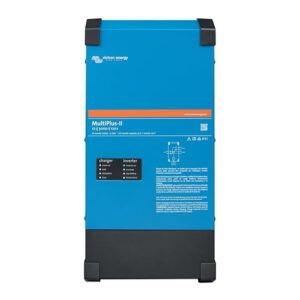
Do you have a start battery and an extra leisure/auxiliary

Introducing the Victron MultiPlus-II: Your All-in-One Solution for Reliable Power
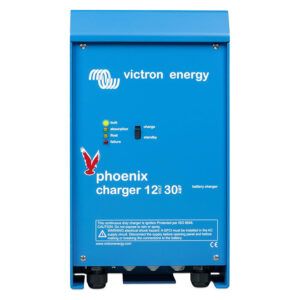
Victron Phoenix Smart IP43 Charger With boat owners in mind
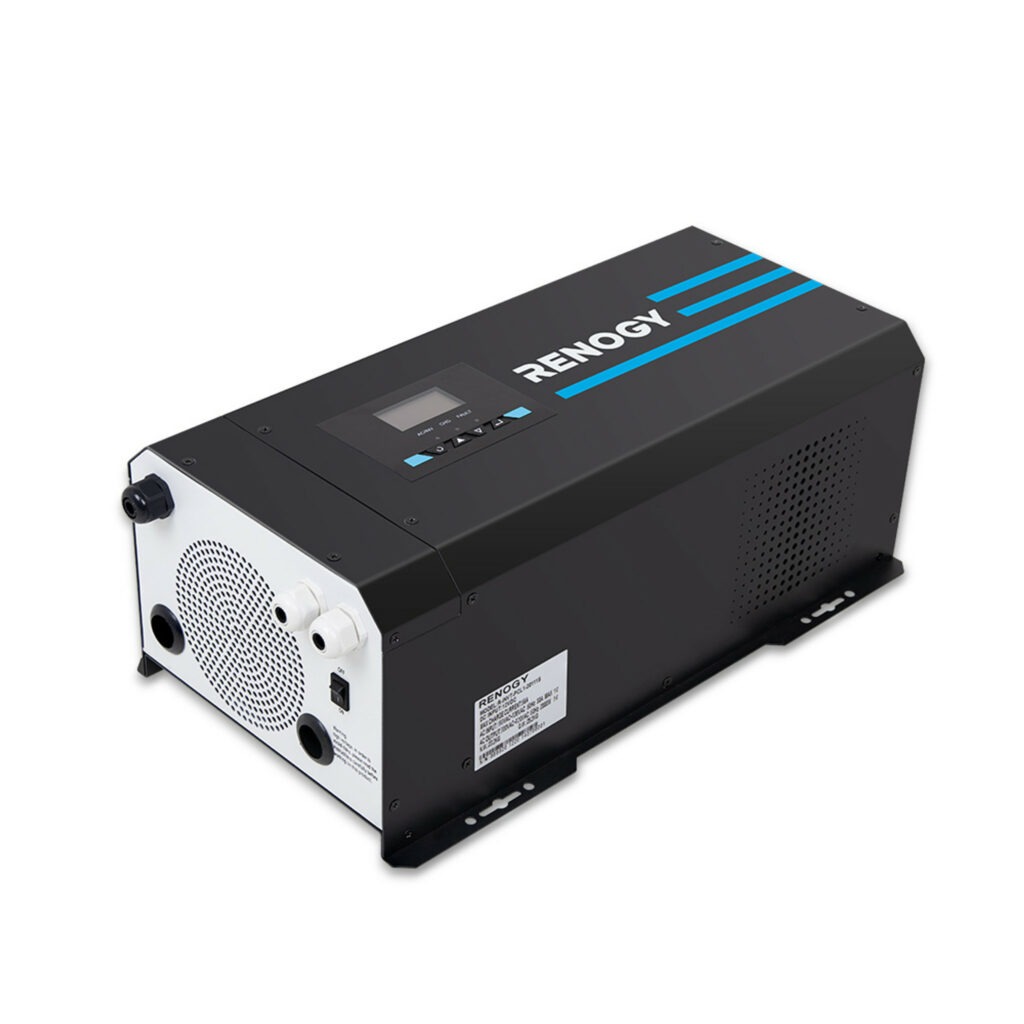
The Renogy 2000W Pure Sine Wave Inverter Charger can be used for multiple applications when going off-grid. A power inverter is an electrical device that transforms the DC power stored in a battery bank into standard household AC power for a user's electronic needs. This device can also charge and maintain a battery bank when connected to shore power and is now compatible with Lithium batteries. With a low transfer time, power remains uninterrupted when switching from solar to shore power. This creates clean and silent energy without having to worry about losing access to connected devices and appliances. The Renogy 2000W Pure Sine Wave Inverter Charger is a perfect back-up power source! |